
Encourage, Equip, Empower
Each month our very own amazing writers from South Texas publish a series of blog posts written with you in mind. Our desire is to encourage, equip, and empower you through stories, experiences, and insights from our writers and from God’s Word.



-
Is God’s Good Enough?
We have heard it said in church all our lives that “God is good all the time and all the time, God is good.” It is taught to us from infancy that God is good and that He is working for our good. As a very young child I started being taught that we cannot…
-
Being Single
I am an author….obviously. I am a teacher, a mother, a daughter, a sister. I am a dog owner. I love coffee, being in my house and I prefer experiences over things. I am a church member, an ordained minister, a college graduate, a musician and a fairly good cook (according to my kids). I…
-
Press In
The word “prayer” tends to evoke images of demure bowed heads in a silent cathedral except for the low reverent hum of an organ thrumming out “Amazing Grace” in the background. I think that’s why so many people find it a hard concept to grasp. “How do I talk to God?” Sometimes, in church circles,…
-
Drop Your Blanket
I know some ladies who live for the Holidays. You know the ones who plan out their home decor with themes and color schemes. Every spot in the house must match the appropriate holiday and colors. If this is you, awesome. I’ll give you my number.
I, however am not one of those women. I am not a decorator, especially when it comes to the holidays. I might strategically place a knick knack here or there, but I don’t really plan these things out. I mean, we almost didn’t even have a Christmas tree this year.
It was 9 days until Christmas, when we finally put up our tree. We decided to do a small one because we just moved a few months ago and we still have things in boxes, and like I said, “9 days until Christmas” doesn’t seem like a lot of time to decorate a big tree and enjoy it.
But we got it done. It looks so pretty and now that Christmas is over, I feel as though I can relax a little. Oh except, now I need to come up with my New Year’s resolutions.
Oh dear, where to begin…well I do know one resolution that I didn’t really keep the way that I had hoped- spending more time with Jesus.
It seemed like such an easy goal, but the truth is I’ve struggled. It’s easy when I can just pull him out of a box when I need something, or I realize I haven’t spoken to him in a while. I need to make sure I check him off my list. The only thing is he should be more than just a check mark.
One of our favorite traditions is watching A Charlie Brown Christmas while decorating the tree. My husband and I started this tradition the first year we were married and continued it with our young daughter.
But this time around when we were decorating the tree, I wasn’t really paying attention to the movie. I’m not even sure I saw but a few scenes. However, I did make sure to have my whole family put down the Christmas lights and the ornaments as we listened and watched Linus’ speech about what Christmas is all about.
He quotes Luke 2:10-12
And there were in the same country shepherds abiding in the field, keeping watch over their flock by night.
9 And, lo, the angel of the Lord came upon them, and the glory of the Lord shone round about them: and they were sore afraid.
10 And the angel said unto them, Fear not: for, behold, I bring you good tidings of great joy, which shall be to all people.
11 For unto you is born this day in the city of David a Saviour, which is Christ the Lord.
12 And this shall be a sign unto you; Ye shall find the babe wrapped in swaddling clothes, lying in a manger.
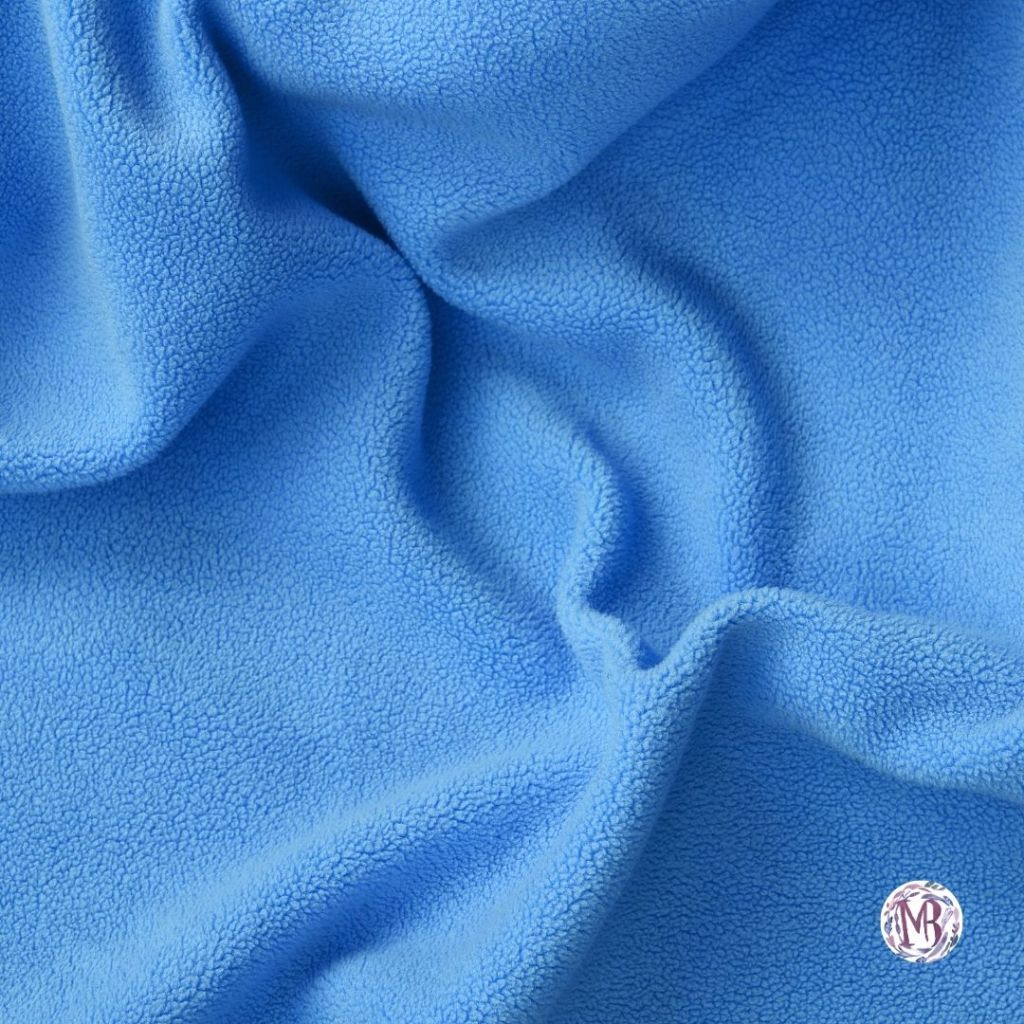
The reason I wanted to watch this scene was because I saw on a reel that while Linus is quoting this powerful scripture, he drops his blanket as he’s saying, “fear not.”
If you’re familiar with his character, he and his blanket do everything together. He’s not one to let go of it lightly. You see, for Linus, his blanket is his security.
The imagery of him dropping his blanket and not picking it up until he’s finished quoting the Christmas Story is a beautiful reminder that Jesus is our Prince of Peace. For a split second, we can see that Linus couldn’t care less about his blanket, because he knows the importance of the story.
My family and I went through a lot of hurt this last year. There was so much uncertainty, and healing from past relationships. There were days when it wouldn’t bother me and days when it would tear me up inside. Just when I thought I was over a situation, something would trigger the hurt and pain all over again.
Many times, we go through difficult trials in our lives, and we hold on to that hurt, shame, loneliness, or anger instead of holding onto our Savior.
I would find myself holding on to these things. It was as if I was walking alone, when I didn’t have to. The reality is, Jesus doesn’t sit in a box, waiting for us to open it and pull him out. No, he’s always right there.
The angels, shepherds and wise men, made a choice to worship Jesus. In fact, we can learn that it took the wise men close to 2 years to even find him. This must have taken a lot of preparation and dedication to pull off. They obviously had to leave their homes, families and put their trust in the Lord.
It took them 2 years to find Jesus, when I have the privilege of knowing him every day. Then why am I allowing myself to continue in this pattern? I’m not spiritually growing, while my hurt and anger continue to grow. I was ready to drop my blanket.
As I was reading Luke 2, I began to realize that Jesus was born in the middle of a filthy stable so that he could save a dying and broken world. He was born in a mess to clean up a mess, and I was a mess. If I’m honest with myself, I still am. But I’m learning to let go of things of the past, and to lean on him more.
When it comes time to put the decorations away, I don’t want to add Jesus to the box. I want him to be the front and center of my life.
So, this coming year don’t make Jesus a check mark or a seasonal ornament. Keep him out of the box and make the choice to drop your blanket and worship him daily.

Melinda Brown is a mother, co-pastor, entrepreneur, and now she can add author to her ever growing list of gifts. She and her husband, Jason, pastor Columbus Community Church in South East Texas and now, Melinda has agreed to come on board as one of our newest authors on the STXWM Blog Team. Her heart is to share the love of Jesus through her writing and to tell the world of the healing and comfort that can be found in a relationship with the Lord.
-
Christmas Cookies & Holiday Hearts

Photo by Jonathan Meyer on Pexels.com I come from a family of singers. None of us are professionals, although my dad and my brother might have been able to make a living in front of a microphone, but we have the innate ability to connect almost any word or phrase to a song or make one up on the spot. Growing up any occasion was the perfect occasion to sing. Loudly.
My life was a near-constant narration through song. My parents would bust through my door in the morning with a rousing chorus of “Wake up wake up! You little sleepy head. Get your little buns into gear!” Trying to get all five of us out the door sounded like a cacophony of shoes stomping and jackets zipping and a sing song reminder to “Lock the doors and turn the lights
down low.” Bedtime never disappointed either. Many nights, my dad would sing, “Goodnight, sweetheart, now it’s time to go,” and then he would say, “To bed, silly head!” And kiss and tickle me until I was too exhausted to protest.
If our everyday life was surrounded by song, holidays were like the Olympics! My mom would play Brenda Lee Christmas classics in the kitchen and the tunes and lyrics would infectiously fill every room and mind until we were all singing some variation of a Christmas song. When I was a little kid, my brother was particularly excited about “Jingle Bells Batman Smells Robin Laid an Egg,” much to the chagrin of my parents.I don’t know if she made it up or when it began to be sung in our home, but my favorite song came from my mom. It was about Christmas cookies and holiday hearts and a little child begging mommy to make more. All five of us would sing it together in varying keys and abilities while we made our family’s version of Christmas cookies: Ritz crackers stuck together with
peanut butter then dipped in melted chocolate and lovingly drowned in sprinkles.
“Christmas cookies and holiday hearts, that’s the way a holiday starts.” My mom would diligently melt bricks of chocolate while my dad laid out yards of wax paper to hold our mountains of cookies.” Mommy, mommy make a little more all the children say.” My sister and I would glue crackers together with peanut butter while my brother dipped them in chocolate. “Mommy
mommy make a little more. Soon its Christmas day. Hey!” We would spill sprinkles and drizzle chocolate and crunch on cookies until the table overflowed. “Goody goody yum yum. Goody goody yum yum. Goody goody yum yum YUM!”We would sing and make cookies for what felt like entire days and I worried there would be a peanut butter shortage! My sister’s cookies always looked the most beautiful because she was so creative and patient. Mine would crack under the pressure of too much peanut butter and an unhealthy amount of sprinkles while my brother would eat more than he made. Our parents would sneak kisses between making cookies, and we would beg to hear their stories of Christmas past.
As a mother now myself I can appreciate the love and intentionality my own parents put into creating such sweet moments. Did they know they were creating core memories? Did they know that Ritz crackers, peanut butter, and chocolate would create a legacy of love and laughter? Probably not, but they did know that time spent together in love has everlasting effects. When we operate in love, we are conduits for God’s love to enter the world and transform not only those around us, but ourselves as well. 1 John 4:16 says, “God is love, and whoever abides in love abides in God.” Verse 19 continues with, “We love because He first loved us.”The Christmas season can be full of wonder, awe, and joy. It can also be full of fear, sorrow, and grief. As sisters in Christ let us choose love. Live, abide, dwell in love, and allow it to change you from the inside out. Then take that love and sow it. Sow it into your spouse, your kids, or your extended family. Sow it into the grouchy coworker, the overworked retail employee,
and the underpaid food service worker. Sow love without thinking about what you get in return.
How do you sow love? Well, it could be Christmas cookies and holiday hearts, but Paul shares a more holistic view in his letter to the church in Corinth.“Love is patient and kind; love does not envy or boast; it is not arrogant or rude. It does not insist on its own way; it is not irritable or resentful; it does not rejoice at wrongdoing, but rejoices with the truth. Love bears all things, believes all things, hopes all things, endures all things.” 1Corinthians 13:4-7
My first Christmas while serving abroad was in a country with less than a 3% population of professing Christians. We had been there six months and I was struggling with deep culture shock, immense homesickness, and infertility. A family we worked with invited us over to their home for dinner a few days before Christmas, and when we arrived, they had purchased
everything to make my family’s Christmas cookies. I wept in graciousness and joy, and together, we shared in the tradition of making cookies, telling stories, and singing songs. A simple tradition sowed in love decades before reaped precious benefits years later not only for myself but for those that chose to love and bring a bit of home to me.
Fast forward to this year. Christmas music is playing, my husband is laying out wax paper for chocolate-dipped cookies, and my toddlers are eagerly smearing peanut butter onto Ritz crackers while I teach them a song about children begging their mommy for Christmas cookies and holiday hearts. More sprinkles are spilled than used, a batch (or two) of chocolate has been
burned, and there are a few tears shed at those who are no longer with us. Sorrow and joy can simultaneously fill a space. This season of Christmas, abide in love and allow King Jesus to sow and reap through your surrendered heart. And maybe lift your voice to a song or two as well.
Lord, I pray that we can lay aside all that the world says is important and worship you. Let us adore you in the mundane and the exciting. I pray for all the women reading this today and ask that you would meet us all where we are and lovingly take our hands and lead us along side you. Give us your eyes for the world around us, Your heart for our neighbors, and a peace
everlasting. In King Jesus’ name. Amen.
MaKenzie V. is a global worker who has faithfully been serving the unreached in the Arab World while growing her family. Almost every moment of the day is spent chasing Jesus and her toddlers- usually with a cup of hot tea or coffee in hand. She enjoys learning languages, deep belly laughs, and connecting with others where God has them.
-
Faith, Family, and Pajamas: Building A Legacy

Photo by Brigitte Tohm on Pexels.com Fifteen years ago, my husband and I were newlyweds, just a year into marriage, and still figuring out life together. Our world was turned upside down when we gained custody of my two youngest siblings. Suddenly, our cozy duo became a family of four. It was a whirlwind of emotions—joy, fear, uncertainty, and hope—all rolled into one.
We were thrown into parenthood overnight with our “Miracle Grow” children. How do you make a group of individuals feel like a family? How do you foster a sense of belonging when everything feels so makeshift? That was the question we wrestled with. As the holiday season approached, we were determined to create traditions to anchor us and make our little family feel real.
That’s when the idea of matching Christmas pajamas was born.
On our first Christmas Eve as a family, we surprised the kids with matching pajamas, and we all wore them as we celebrated Christmas morning. It was a simple act, but it meant so much. It was something we did together as a family, something that was uniquely ours.
Starting something new can be daunting. Whether creating traditions, stepping into a new role, or building a life from scratch, the fear of failure often looms. As I reflect on those moments, I think of Abraham, who God called to leave everything familiar and go to a place he didn’t know. Genesis 12:1-2 says:
“The Lord had said to Abram, ‘Go from your country, your people and your father’s household to the land I will show you. I will make you into a great nation, and I will bless you; I will make your name great, and you will be a blessing.’”
Abraham didn’t have footsteps to follow or traditions to fall back on. He had to trust God and step forward in faith, even when the destination was unclear. His willingness to begin something new became the foundation of a legacy that would bless generations.
Looking back now, it seems almost silly to compare “Father Abraham,” the patriarch of nations, to “Sister Tracie,” a 20-something figuring out how to make dinner for four. But in those first few years of creating our family, everything felt huge and daunting. Every decision, from setting bedtime routines to choosing Christmas traditions, seemed monumental. We weren’t just navigating parenthood; we were building a home where broken pieces could come together and feel whole again. Like Abraham stepping into the unknown, we faced uncharted territory, clinging to faith that God would guide us and that our small, imperfect efforts would ultimately matter.
Sometimes, you’re blessed to inherit rich traditions passed down through generations. But sometimes, you have to be the first. And I’ve discovered through many years that there’s a unique beauty in that. Starting something new is an opportunity to infuse your values, your faith, and your love into a tradition that can grow and evolve with your family.
Our Christmas pajama tradition started small—just matching sleepwear and a few laughs. But it’s become a cherished part of our family identity over the years. Now, with our eight-year-old child, we still celebrate every Christmas Eve in matching pajamas, reliving those moments of togetherness and joy. What began as a way to make our blended family feel whole has turned into a legacy that we hope all of the children we have raised will carry on someday with their own families.
Creating your own traditions isn’t just about the here and now; it’s about planting seeds that will grow into something lasting and meaningful for the future. Traditions are the stories families tell through their actions, the habits that shape who we are and who we want to become. The Bible reminds us in Proverbs 13:22, “A good person leaves an inheritance for their children’s children.” This inheritance isn’t limited to material wealth or possessions. The values we uphold, the faith we nurture, and the love we pour into the moments seem ordinary but carry extraordinary meaning over time.
If you find yourself in a season of starting from scratch, know this: you’re not alone. God often calls us to begin new things, not because it’s easy, but because He has a greater purpose for us that we can’t yet see. Even in seasons of uncertainty, when new beginnings feel overwhelming, new traditions can remind us of the potential for something beautiful to grow. In this season, not only the Christmas season but this season of life, lean into His guidance and trust that your beginnings, no matter how small, can be used by God to glorify Him and create a legacy that reflects His love and faithfulness for generations to come.

Tracie Tevault is a recent addition to the STXWM blog team, and she’s excited to share her journey and connect with others through her writing. Married for 15 years to her best friend, Tracie is raising one awesome son and three spoiled cats who definitely rule the house. With a heart for ministry, Tracie has served in many areas, but her true passion lies in reaching those who might not fit the traditional church mold. She’s all about showing people they are loved, valued, and created with a purpose. Quirky, loud, and always ready for a good laugh, Tracie brings a fun-loving energy to everything she does. When she’s not writing or serving, you’ll find her hanging out with her family, discovering her newest crafting hyper fixation, and finding inspiration from God in the everyday moments.
-
Christmas Mice

I have mice in my Christmas tree every year. Allow me to elaborate. My very first Christmas after college, I was newly married and my husband and I were newly installed as Associate Pastors at a rural church in North Texas settled in cotton farming country. As part of our pay, we were allowed to live in the church parsonage on the property rent free! What a blessing! We were ecstatic to be in ministry and felt so blessed to be in this two bedroom home after spending the first year of our marriage in a 550 square foot, one bedroom, third floor walk up. That first Christmas we were on a sharp learning curve about life in the country. Part of our education came in the form of some Christmas visitors.
When Christmas time came around we went to Walmart and got a real tree and a $3 string of Christmas lights but we had no ornaments, so we decided to decorate with candy canes. I was so proud of our first tree, humble as it was. As Christmas got closer, we started getting into small squabbles about who was eating our candy canes. I thought he was doing it and he thought it was me; a minor annoyance for sure, but it soon became almost a daily conversation. One night, as we sat on the couch watching TV, I saw some motion out of the corner of my eye near the tree. As we turned our attention to it, we watched as one of the candy canes began to shake, and then move in short, jerky motions, and then disappear completely into the tree! Naturally, I reacted as calmly as you would expect. I jumped up onto the couch and screamed for my husband to go ahead of me to investigate. He turned off the lights in the room but left the Christmas lights on. In their glow we saw mice; not just one but several mice that appeared to have taken up residence in our tree with its endless supply of candy canes.
I had a mix of feelings which was overwhelmingly fear but also embarrassment. I worried about what people would think if they knew we had a rodent problem! We tried for several weeks to deal with it ourselves without telling a soul but soon, I felt comfortable enough with a sweet friend in the church to share it with her. I cried and poured out my heart about all of my fear and embarrassment over the situation and asked her sincerely not to think badly of us for having brought this problem into the house that the church had so graciously allowed us to live in while we served there. She smiled the most precious smile and I knew immediately that I was loved and accepted and that this situation did not change her opinion of me in any way. I thanked her and asked her what I should do. I told her everything we had tried so far. She laughed and said, “I gave up and learned to live with it a long time ago.” I was stunned. What?! She went on to explain that this community had not had a new build in decades. All the houses were old, wood frame buildings and all sprinkled in the middle of a community of cotton fields. Mice were a fact of life out here in the winter.
I was dumbfounded. I had been stressing and worrying and FEARING for weeks over a non-issue. I had convinced myself that this perceived problem was a humiliation; something that would cause others to value me less once they knew it about me.
This started a tradition of making our own ornaments. That year I made mouse ornaments and I made a lot of them. Every year since, we have had mice in our Christmas tree and it is one of my children’s favorite stories to hear at Christmas time but for me, it’s a reminder. I am reminded that God is present with us in all of life’s seasons. Often when I am walking through a difficult time, it can feel so all-consuming that I forget that it’s not. The enemy can use our difficult times to taunt us with shame to keep us isolated from each other, but God desires for us to encourage each other and lift each other up. That is not to say that those times are insignificant or that my pain is not real, but I have found that walking through those times with a faithful, loving God and Godly sisters by my side can, not only get me through, but can often help me to settle into a new normal that I once thought I would never survive. The story of the mice is a light and fun example of a very real truth for times when things are not-so-fun or light.
Thirteen years ago my marriage ended and I struggled to become accustomed to my new normal; a divorced, single mom of three. At the time I told God what I needed Him to do. (I know that you have never done that before. LOL) I told Him then that I would not survive without my kids and He needed to be sure I never had to be without them. Then He walked with me as I became accustomed to weekends and holidays on my own. For a time, every one felt like I was going to die. I would work, make plans with friends, and do anything I could to stay busy but at night, in an empty house I would cry out to God and He would get me through til morning. Eventually, I settled into that new normal as well.
Three years ago two of my children went to live with their dad and our roles were reversed. That began my journey as the parent who gets “visits” instead of the one providing full time care and for a time, I thought it might kill me. I even had loving friends who assured me that God would send them home. Through tears I committed to God that I would faithfully serve Him even if He didn’t.
Those things which I told God were too much for me to bear were actually just too much for me to bear alone. I still miss my kids every single day. I still struggle sometimes between my weekends and holidays when they are home with me but I know that I am not walking alone and I know that those things that I once feared would end me are not greater than my God.
As much as we would all like to believe that the joy and fun of this holiday season is a reality for everyone, unfortunately for some it is not. If this time of year has come on top of a difficult season in your life, I am praying sincerely for deliverance, healing, provision and abundance for you and your home but know that wherever you walk God is going to be in front of you and by your side every step of the way.
In Deuteronomy 31:8 Moses encouraged Joshua with these words and I believe they are a promise to all believers:
“Do not be afraid or discouraged for the Lord will personally go ahead of you. He will be with you; He will neither fail nor abandon you.”
-
An Arrow Not a Crown
Last year, I spent Mother’s Day in Italy. That weekend, we hiked through the Italian Alps to the Church in the Cliff (Corona della Madonna). That particular church is perched on the side of a mountain, 1200 feet from the top and 1200 feet from the valley below.

We parked at the peak and made our descent through beautiful and misty woods. The steep path to the church was adorned with life-size stations of the cross: the Passion of the Christ played out in fourteen bronze scenes; culminating in the resurrection and ascension. Every step was a sermon: the mountain air burst through my lungs, reminded me I was alive and it was a gift. The culminating stations assured me; my Savior was with me every step of the way. And the church carved into the cliff overhang convinced me: my most secure life was nestled in Him.
“I love You, Lord, my strength. The Lord is my rock, my fortress and my deliverer; my God is my rock in whom I take refuge, my shield and the horn of salvation, my stronghold.” (Psalm 18:2 NIV)
I had been drawn to the Church in the Cliff since I first learned of it. My Italian friend had sent a list of potential outings and upon googling, I was immediately engrossed. I had to see it firsthand; a stone tabernacle hewn into the side of a mountain. Monks had built the structure in 1530, and it remains accessible only by a dizzying and difficult path. It was an hour’s hard hike from the village above, we made most of the downward trek in silence.

At last, we ascended the last stone stair (a replica of the staircase into Pilate’s palace). When we crossed the threshold, I was accosted by the bronze and marble image on the altar. Mary, the mother, cradled her fallen Son, the Savior of the world. It was a replica of the Pieta, a famous work by Michelangelo and familiar to my heart: I did a pen and ink version in high school. But the assault was the addition of a golden crown upon Mary’s head. Jesus, fallen. Mary, exalted.

I sunk into a pew to catch my breath and consider the implications. Most Catholics regard Mary as sinless, but scripture assures us of her humanity and her need for a Savior. (See Luke 1:47, Mark 3:20, John 2:4, Romans 3:23) To come such a long way to find such an altar was a little shocking to my system. And still, I knew I was meant to make that trek.
I sat for a moment in that stone sanctuary and considered the imagery. Worship lyrics came to me: “For You Wear the Victor’s Crown.” The crown belongs to the King, not the mother.
The Madonna in the stone church made me think of motherhood. So often we crown mom as the hero of the home: the one who holds the family together and sacrifices herself on the altar of her children. While it is right to honor mom, but we cannot lose sight of the true champion in every home: Jesus is the strength a good mother must be girded in. Mothering apart from His presence is frustrating and futile. Without Him, we are weak and willful. He hones us and perfects us through the process of motherhood.
“But women will be saved through childbearing – if they continue in faith, love and holiness with propriety.” (1 Timothy 2:15 NIV)
We require a divine assist in the crucible of motherhood. When we cry out, He comforts. Where we lack, He leads. We fail, He furthers His purposes. This cooperation over a lifetime of parenting produces sanctification: we are made more like Him.
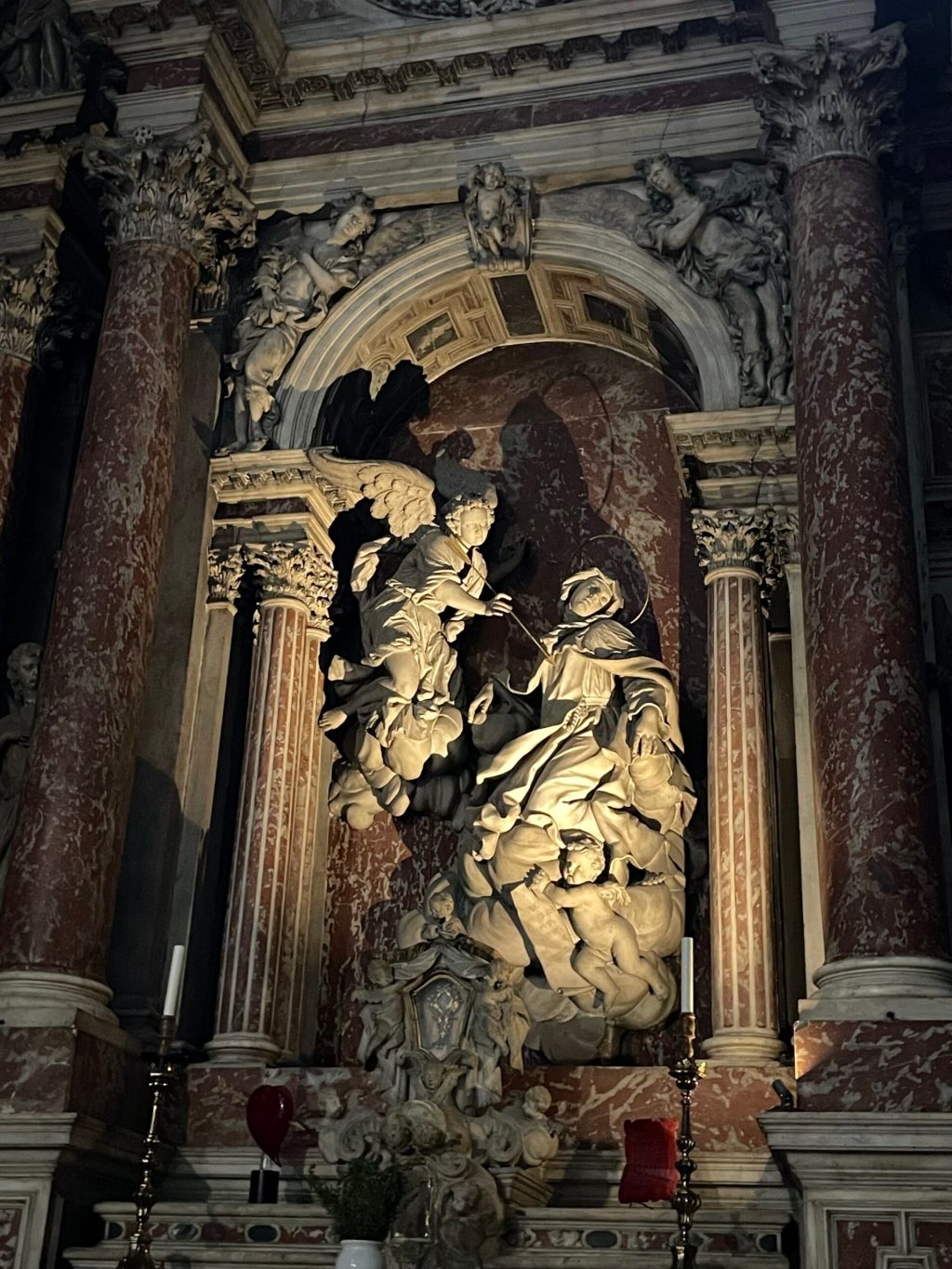
While the altar in the Cliff Church sat uneasy in my mind, I was reminded of still another sanctuary amid our Italian tour. There was a church in Venice that we had visited and its imagery is still stuck in my imagination: Mary struck by an arrow from an angel. I believe it was an artist’s interpretation of Simon’s word to Jesus’ mother in Luke 2. It felt like a far more accurate portrait of motherhood.
“And a sword will pierce your own soul, too.” (Luke 2:35 NIV)
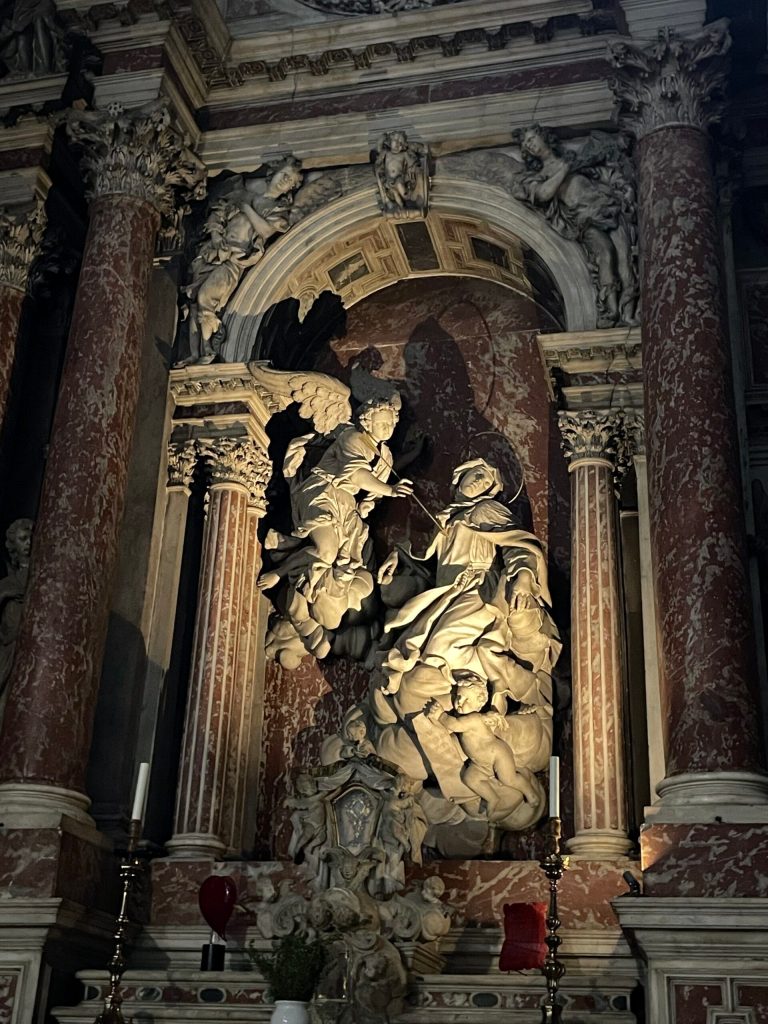
Motherhood is not a crown on the brow, but an arrow in the chest. We wrestle with our will and our flesh as we raise up and let go. In this ongoing piercing, we endlessly require God’s presence. We mother best when we rely on Him most.
“Many women do notable things, but you surpass them all. Charm is deceptive, and beauty is fleeting, but a woman who fears the Lord is to be praised.” (Proverbs 31:29-30 NIV)
The wisest king in the history of humanity reminds mommas everywhere: the most notable thing a mother can do is fear the Lord. Holy fear keeps the crown from falling on our own head and Christ receives the glory He is due.
Lord, amidst this journey of motherhood, keep our eyes and hearts fixed above. You alone wear the crown. Keep us breathing even as arrows pierce. Sanctify us as we continue to lean in for strength. Amen.

About STX Women
We are the Women’s Ministries branch of the South Texas Assemblies of God.
Women across South Texas desire a community where we celebrate each other and share each other’s burdens.
Together, we walk out our God-given purpose in our family, church, and community!
Our passion and love for Christ unite us to reach the lost at home and across the world.
Follow Us On:
Subscribe To Our Emails
Enter your email address below to get our new blog posts sent right to your inbox!

