
Encourage, Equip, Empower
Each month our very own amazing writers from South Texas publish a series of blog posts written with you in mind. Our desire is to encourage, equip, and empower you through stories, experiences, and insights from our writers and from God’s Word.



-
Is God’s Good Enough?
We have heard it said in church all our lives that “God is good all the time and all the time, God is good.” It is taught to us from infancy that God is good and that He is working for our good. As a very young child I started being taught that we cannot…
-
Being Single
I am an author….obviously. I am a teacher, a mother, a daughter, a sister. I am a dog owner. I love coffee, being in my house and I prefer experiences over things. I am a church member, an ordained minister, a college graduate, a musician and a fairly good cook (according to my kids). I…
-
Press In
The word “prayer” tends to evoke images of demure bowed heads in a silent cathedral except for the low reverent hum of an organ thrumming out “Amazing Grace” in the background. I think that’s why so many people find it a hard concept to grasp. “How do I talk to God?” Sometimes, in church circles,…
-
Letting Go & Embracing Faith

It felt strange to be back again. I know we still had to move our things out, but just being back made me feel empty inside.
This was no longer our home, and we were no longer needed here. The Lord had called us away to a new assignment in a new place.
What once was, was no more…
We had called the Gulf Coast our home for almost 13 years, but everything is different now. It had been for some time. You never know when your life will change.
But it was time to move on, to what we believe is better.
Let’s rewind to last year, when I found myself feeling hurt and lost. I kind of thought I would never recover. My heart was too broken to try to pick up all the pieces.
However, moving on was the only way I could heal.
I spent the next 9 months meeting new people and allowing myself to be vulnerable again. It really helped me break out of the shell that I had crawled into.
I was reconnecting with old friends, and I was able to make new ones too!
But God wasn’t done there. He had more for my family and me. I just wasn’t sure I was ready for any more change.
They say, “time heals all wounds”, but who’s the one that measures that time?
Ecclesiastes 3:1-8
1 “There is a time for everything,
and a season for every activity under the heavens:2 a time to be born and a time to die,
a time to plant and a time to uproot,
3 a time to kill and a time to heal,
a time to tear down and a time to build,
4 a time to weep and a time to laugh,
a time to mourn and a time to dance,
5 a time to scatter stones and a time to gather them,
a time to embrace and a time to refrain from embracing,
6 a time to search and a time to give up,
a time to keep and a time to throw away,
7 a time to tear and a time to mend,
a time to be silent and a time to speak,
8 a time to love and a time to hate,
a time for war and a time for peace.”God is the one who is orchestrating my life. He’s the one who holds the stopwatch. He knew the exact moment that I would fall apart, and the exact moment that I would be okay again. And I was okay again. I was okay for a while, because God didn’t create us to walk this world alone. He called us to connect with one another.
Change is an inevitable part of life. Whether you want to embrace it or not, it happens. My daughter will be 6 this spring, and I feel like it was just yesterday I was cradling my belly and preparing for her arrival.
But now we’re talking about updating her room and putting together a Barbie Birthday Party for her including a bounce house, balloons, pizza, and cake. She even wants to invite boys to her party! What is happening?
This change is fun, scary and a little overwhelming, but I know that I have support. Just like I did a few months ago when we moved to the country.
This was the new assignment that the Lord was calling us to- Columbus, Texas. Where we know NO ONE. Haha, God’s a prankster. No really, he always knows what we need when we need it. Just like Ecclesiastes 3 says.
We had to let go of the past, to move forward, but we had to take that time to heal first.
God gave us time to heal and grow in those new friendships, so that we could embrace our new ones.
I’ve got to be honest; it wasn’t easy moving to a new town and meeting new people. I began second guessing myself. This made me feel miserable and alone. Was it worth it to alter who I was?
After some time of reflection and prayer, the Lord reminded me that I’m not meant to be alone.
Ecclesiastes 4:9-12 helped me understand the importance of companionship and support. This scripture is the foundation upon which we, the South Texas AG Women, stand: “Two are better than one because they have a good return for their labor. If either of them falls down, one can help the other up.”
Before we made a clear decision about moving to Columbus and pastoring again, we had to be willing to continue to put ourselves out there.
We had our church family constantly praying for us and lifting us up. We knew God was calling us to something new.
It was a Sunday morning service that spoke to both my husband and me. That was the moment we knew; it was time to walk out in faith.
To think that just in the last two years, so much had changed in my life that made me feel alone. But God brought me true friends who helped me find joy again. Now, he’s asking me to be that same support and healing for other women, just as they were for me.
By sharing my story and the healing I have found, I hope to help others let go of their pasts and embrace new beginnings with the same audacious faith.
We are better together, and with God’s guidance, we can be true friends and a source of strength for one another.
Proverbs 27:9
“The heartfelt counsel of a friend is as sweet as perfume and incense.”
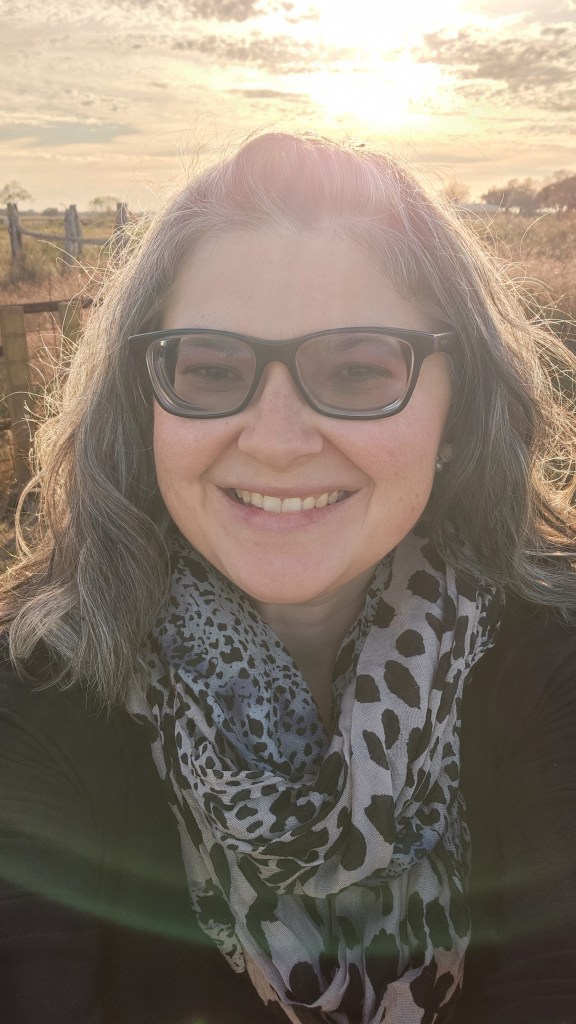
Melinda Brown is a mother, co-pastor, entrepreneur, and now she can add author to her ever growing list of gifts. She and her husband, Jason, pastor Columbus Community Church in South East Texas and now, Melinda has agreed to come on board as one of our newest authors on the STXWM Blog Team. Her heart is to share the love of Jesus through her writing and to tell the world of the healing and comfort that can be found in a relationship with the Lord.
-
Audacious Change

I have never been good at change; small changes (like going to a different
grocery store or taking a new route to a familiar place) to the larger scale
changes (like moving to a new country and learning a new language). I
buck and fight and cry and lament, much to the chagrin of my saint of a
husband. Change isn’t a good look on me.Many of you might be “amening” and nodding your heads with me while
others can’t fathom a week without a change. Others are change addicts! I
once had a roommate that would rearrange our home, sometimes in the
span of a university lecture! How she was able to move huge pieces of
furniture so quickly is between her and God. I might not have liked it, but I
can’t say it wasn’t impressive.One January, six years ago today actually, I buried my first-born child. A
beautiful daughter with a flower name, Lily Green. The Lord gave my
husband and I her name after we were declared infertile. Daniel prayed
Matthew 6:28-29, “Why are you anxious for clothing? And consider the lilies
of the field, how they grow. They neither toil nor spin, and yet I tell you,
even Solomon in all of his glory was not arrayed like one of these.” We
rejoiced when I became pregnant, and we mourned when she quietly left
this earth shortly before birth. After a lifetime of hating change, I had finally
been excited for the biggest change of all. One of the silently cruel parts of
her death was how life didn’t seem to change at all. Too quickly my body
healed, the nursery was packed up, and life seemingly went back to the
way it had always been. But my heart, my very soul, was irrevocably changed.Death isn’t the only change that can bring sorrow, suffering, and grief. A
dream defeated, a hope deferred, a relationship ruined–all of these
changes (or seemingly the antithesis of change) birth an abundance of
emotions inside of us. When we are confronted with various feelings
competing to be felt, especially if we have an unhealthy worldview, we can
become shells of ourselves. Imposters even. God does not desire for us to
be whitewashed tombs; shining faces with rot and decay lurking under a
few layers of skin. Our King desires redemption, not just for our
circumstances but also for our souls.I miss Lily Green more fervently than I could even possibly say to you. It’s
an ache that begins in my soul and often leaks from my eyes and squeezes
with each breath I take. Each day there are reminders of what should have
been and what is not. However, change isn’t the enemy. Death isn’t even
the enemy. More times than not it is my very own flesh. Romans 8:6 says,
“To set the mind on the flesh is death, but to set the mind on the Spirit is life
and peace.” Perhaps to embrace change looks like allowing the
circumstances you find yourself in to be filtered through a spiritual lens
rather than an earthly one. To embrace peace and the King who ushers it
in, instead of allowing our flesh and its sinful desires to undermine what our
souls truly long for.“For I consider that the sufferings of this present time are not worth
comparing with the glory that is to be revealed to us…And we know for
those who love God all things work together for good, for those who are
called according to his purpose.” Romans 8:18, 28.No one will ever be able to convince me that change is good or that my
daughter’s death was good in the sense that we understand now. However,
I do know this: that the God of the universe, who saw His creation and said
that it was good, then witnessed that very creation invite sin into what was
perfect, had His heart broken with the corruption of His perfect world. That
same God put on flesh and came to our world as a baby; born to die for the
sins of all mankind. That is good news. A beautiful reason to embrace
unforeseen and unwanted changes in our own lives so that we may not
perish but have everlasting life.Six years ago my life changed more than I could recognize. God, having
felt the immeasurable grief change can bring, took every step with me then
and he continues to lead me now. Just like he leads you. Through
mountains and valleys, seasons of fallow and seasons of abundance, and
life and death, I challenge you to allow King Jesus to lead you.You may have scrolled past the cover photo accompanying this blog or perhaps your attention was snagged and you studied it intently. This is a picture hanging in the home of a dear friend of mine. A college student she knows from Chi Alpha painted this for her after she shared with her that her daughter had passed away. When my four-year-old saw this picture she joyfully exclaimed, “Look mama it’s Lily in Heaven.” In my darkest hours of overwhelming grief, God granted me a glimpse of Heaven. There was a landscape of green, teeming with wildflowers. I never saw her face but I saw a little girl much like this one: blonde hair and a flowing dress laughing and playing without fear or pain. I saw many children in this dream, and I remember trying to get to her; to get her attention. As I picked up my hand to wave at her and call her name, another hand touched my shoulder. Joy radiated from the man next to me; joy and love. He took my hand and kissed it and held it for a moment. Then he gently led me away all the while holding my hand with his other arm around my shoulders. I remember waking up and feeling lighter. A realization that I hadn’t failed my daughter; I had not abandoned her by not following her into death. Someone far grander than I was taking care of her, and instead of me leading her in this life I will worship alongside her in the next.
I love what another STXWM blogger, Tracie, said earlier this month; new
year, same me. There can be so much fanfare when a new year is ushered
in, fireworks, countdowns, and stylish parties. But what happens when a
new year comes and with it all your unresolved prayers, fears, and
expectations? Does ‘all things new’ include our spiritual selves? Have you
wiped clean the proverbial slate between ourselves and others? Between
you and God? Have we sought redemption where wronged, and restoration
where sin separated? Let us boldly abandon what entangles and
audaciously grasp what God has for us. As I continue to seek God in
healing and grieving, I pledge to intercede on your behalf. Whether you are
reading this in 2025 or 2027 or the year 3000, you can confidently know
that you are beloved by God and covered in prayers by your sister in Christ.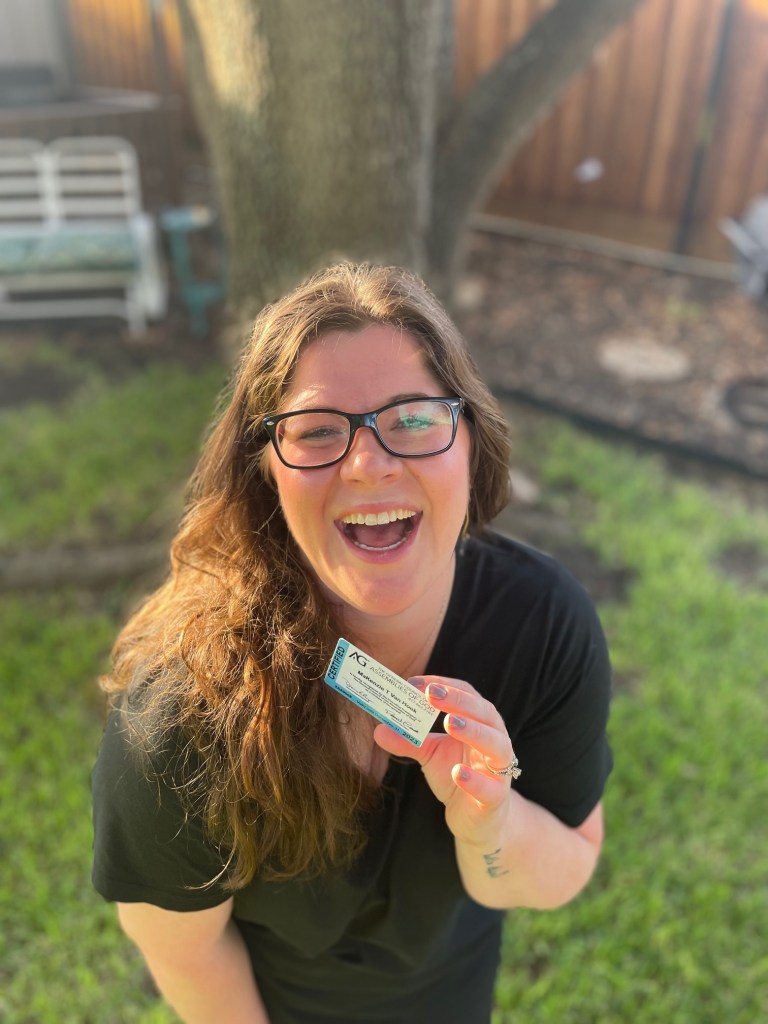
MaKenzie V. is a global worker who has faithfully been serving the unreached in the Arab World while growing her family. Almost every moment of the day is spent chasing Jesus and her toddlers- usually with a cup of hot tea or coffee in hand. She enjoys learning languages, deep belly laughs, and connecting with others where God has them.
-
When Your New Season Isn’t What You Hoped For

We received a text message:
“Can you guys meet for a quick Zoom call?”
We had our suspicions about what they needed to tell us, and they were confirmed a few minutes later over video chat. Our team leaders had accepted a new position and would be transitioning out of their current role, which meant we would be expected to step up and take on new leadership responsibilities. It was going to be a new experience, a new transition, a new team dynamic.
A few months later, as we were clumsily navigating our new role, I had the thought,
“I didn’t ask for this.”
I was wrestling with all the new things that had been thrust upon us, and feeling very overwhelmed and vulnerable. We hadn’t asked for this new role, and to be honest, I didn’t want it. I had my list of really good reasons why we weren’t the people for this job, why we were unqualified, why it was unfair and unrealistic.
Sometimes the new seasons we step into aren’t ones we hoped for.
So what do we do when we find ourselves in a new season, wondering how we got there and whether or not the Lord made a mistake or missed a detail because we just can’t seem to make sense of it all? How do we respond to coming change when the change that’s coming isn’t what we wanted or hoped for?
—–
This year, my oldest daughter will graduate from high school. As cross-cultural workers, not only will we be sending her off to college, but we will be leaving her on another continent while we return to the field. We will watch her say goodbye to her home here in Southeast Asia, knowing it’s very unlikely she will ever live here again. We’ll fly to America a party of five, and return to Asia a party of four. The grief of it all feels like too much.
I know this new season is necessary and right, but if I’m being totally honest, I don’t want to go through it. And just like the Zoom call with our teammates that brought on unexpected change in our jobs and roles, I am wrestling with the tension that comes from wanting to believe that God is good when the new season we’re forced into doesn’t feel good.
—–
After a year of resisting our new leadership position, trying to convince the Lord He got it wrong, I found myself in a worship service singing, “You are worthy of it all.” As those words slipped easily off my lips, the Spirit asked me,
“Am I also worthy of your weakness?”
I realized that my resistance to the new season I found myself in wasn’t so much about the job title or role or responsibility, it was about the weakness I felt in it. The vulnerability of doing what we feel unqualified for, incapable of, or unprepared for often causes us to resist the new thing rather than embracing our weakness and seeing it as an opportunity for God’s strength to be made perfect in us.
“Each time he said, “My grace is all you need. My power works best in weakness.” -2 Cor. 12:9a
We talk about giving our best to the Lord, which He is absolutely worthy of, but He doesn’t just ask for our best. He asks for ALL of us— our worst, our brokenness, our flaws, our insecurities, our weaknesses. When I neglect to surrender my struggles and only offer my strengths, I carry a weight of shame that keeps me from walking in His freedom in the new seasons and opportunities He brings me.
New seasons that are unwanted or unexpected are going to highlight our weaknesses, and perhaps that’s exactly why the Lord allows them. The discomfort of living out of our weakness calls us to humility and surrender, and there we find a divine strength that we cannot embody lest we embrace our weakness— not a strength we must or conjure up in the face of difficulty, but the very power of Christ at work in us.
“That’s why I take pleasure in my weaknesses, and in the insults, hardships, persecutions, and troubles that I suffer for Christ. For when I am weak, then I am strong.” -2 Cor. 12:10
It’s been three years since that Zoom call, and while the road has not been easy, I can see how the Lord used that unexpected new season to do a formational work in my heart and life. Once I stopped fighting it, surrendered my weakness, and embraced the new thing God wanted to do, He has delighted me with His presence and strength in beautiful ways.
The thought of the new season to come for our family this year still puts a lump in my throat, but I am clinging to the hope that when I feel utterly weak and the path ahead feels impossible to traverse, I have a faithful friend who is familiar with the Way of Weakness, and who will be with me and impart to me His strength every step of the way.
He isn’t leading us into these challenging new seasons because we are strong enough for them, but because HE is.

Embracing our weakness in the seasons we didn’t ask for or want takes an audacious faith that chooses to believe God’s grace truly is all we need. Perhaps you find yourself looking at some undesired changes ahead in 2025. Maybe you’re already in the midst of a new season you are struggling to accept. When we choose to surrender our worries and weaknesses to Christ, we are making space for the unfailing strength of our Savior to uphold us and empower us to walk forward with faith into the unknowns ahead. Faithfully carry those weaknesses, doubts, concerns, griefs, and worries to the Lord in prayer and let His mighty presence renew you and remind you that even when things don’t feel good, He is still good.
Author, Heather F.
-
New Year, Same Me

Photo by Matheus Bertelli on Pexels.com As I’ve gotten older, New Year’s Eve has become less and less about getting dolled up and going out and more and more about whose house we’ll hang out at while we play games and guess whose kid will pass out first. The truth is, I’m not much of a fan of New Year’s. Between the disappointment in broken resolutions and it taking the entire month of January for me to remember not to write “2024,” I am a big believer in the “new year, same me” revolution. It’s simpler, it’s more realistic, and honestly, it’s more in line with what I read in my Bible.
Don’t get me wrong, I’m all for a fresh start. I’m here for goal-setting, gym memberships, and that vague feeling of optimism that a new year brings. But let’s be real: the odds of sticking to a resolution for 365 days are about the same as my 8-year-old not calling me “bruh” for a whole day. Not happening. That’s why I love what the Bible says about “newness.” It doesn’t make us wait until January 1st to experience it. God’s mercies are new every morning. Every. Single. Day.
So, if you’re like me and you’ve already broken your resolution by the 3rd of January (or maybe you’ve just made 47 new ones by now), take heart because you’re not alone and you are not a failure. God’s mercies are there, fresh as a morning cup of coffee every day. And that, my friends, is the ultimate fresh start.
Every year, we all go a little crazy with the idea that this year will be different. We’ve got a list of resolutions: lose weight, stop procrastinating, read more, be more patient, learn a new language, start a podcast—whatever. The “fresh start” energy is real; we feel like superheroes for about 72 hours. But by the time the excitement of the New Year’s confetti has settled, reality starts to creep in. The gym? Packed with newbies who are now fighting for the last parking spot. The diet? The leftover cookies from Christmas are calling your name in the kitchen. The “new me” thing? Well, the “same me” seems to be showing up again. And guess what? That’s actually okay.
The idea of the “new year, new me” can be inspiring—until you realize you’re not as “new” as you thought. But here’s where we get to flip the script a little bit. The Bible doesn’t give us the luxury of a clean slate only once a year. God’s mercies are fresh every morning, not just on January 1st. And that’s not just a poetic saying; that’s a promise. No matter how many times we fall short, God is there to pick us up again. Every day is a new opportunity to walk in His grace.
The Daily Reset
Let’s be honest: life is messy. Our plans don’t always work out, our resolutions get buried under piles of laundry, and our good intentions often crumble when the coffee kicks in. But the beauty of God’s mercies is that they don’t expire. Lamentations 3:22-23 reminds us: “The faithful love of the LORD never ends! His mercies never cease. Great is his faithfulness; his mercies begin afresh each morning.”
So, if you ate the entire bag of chips yesterday (guilty), or you snapped at your kid when you had to ask them 6 times to put on their shoes this morning (also guilty), guess what? God’s mercies are still fresh for you today. It’s like having a daily reset button that we can press over and over, no matter how many times we mess up.
This doesn’t mean we should give ourselves a free pass to be lazy or live without purpose. It doesn’t mean there’s no value in making goals or working hard to become better versions of ourselves. But it does mean that when we fail—and we will fail—there’s grace. The same grace that gives us a fresh start at the beginning of the year is available every single morning.
You might be thinking, “Okay, that sounds nice and all, but what if I really want to try and do better this year?” I get it. We all want to improve. I’m right there with you. But let me remind you that the “new year, new me” vibe that society sells us is very much performance-based. It’s about the doing—the self-discipline, the grinding, the hustling. It puts pressure on us to be flawless, to show up perfect, and to be the best version of ourselves. And if we’re being honest, that pressure is exhausting.
But God offers us something different: grace. Instead of trying to “be better” on our own, He calls us to rest in Him and rely on His strength. God’s mercy is not something we have to earn or achieve—it’s a gift. When we fall short, God’s grace is there to pick us up. We don’t have to wait until next New Year’s Eve to start over; we get another shot every morning we wake up. This is another chance to move closer to the person God has made us to be.
I’m not saying you shouldn’t strive to be better in the new year. You can still make resolutions! But maybe, just maybe, we should stop making them about our own ability to do it all perfectly. Perhaps this year, instead of trying to be “the new me,” we focus on letting God shape us day by day. Maybe we resolve to accept His mercies every morning, to extend grace to ourselves when we fall short, and to trust that God’s work in us is happening, even when we don’t see instant results.
This year, let’s make the “same me” revolution one rooted in God’s never-ending love and grace. While the world may offer us a “new year, new you,” God’s Word gives us something far better: new mercies every morning.
So, whether you’ve stuck to your New Year’s resolution or have come up with a new one every single day, it doesn’t matter. God is still there, faithfully offering fresh grace to meet you where you are. And that’s the kind of fresh start that lasts.
Happy New Year, friends. Same you, but with new mercies, every day. Isn’t that just the best kind of start?
This idea of new mercies every morning is an invitation to live with audacious faith—the kind of faith that says, “I may not be perfect, but I trust that God’s grace is bigger than my failures.” Audacious faith is the confidence to step into each day knowing that, no matter how many times we fall short, God’s love and mercy are unshakable. It’s about trusting that God is at work in us, even when we can’t see the immediate results. When we embrace the fact that our “newness” doesn’t depend on us, but on His unfailing grace, we’re free to take bold steps, make mistakes, and keep getting back up. Living with audacious faith means we can look at our “same me” confidently, knowing God is making all things new—one grace-filled morning at a time.
Author, Tracie Tevault

-
Audacious Faith

When I first heard this year’s theme, I’ll admit, I had to do some research. Audacious is not a word we hear often in everyday conversation. My good friend, MaKenzie V., is brilliant with languages and had already done some of this research before I ever started. She was gracious enough to share the following with me:
Audacious is an adjective meaning “intrepidly daring, adventurous, and recklessly bold.” Some synonyms include bold, brazen, cheeky, cocky, impertinent, sassy, and nervy. Alternately, antonyms for Audacious include careful, cautious, guarded, prudent, safe, and wary.
Now that we know what Audacious means, what is faith? I didn’t go to the dictionary for this one. Hebrews 11 tells us that (1) “Faith shows the reality of what we hope for; it is the evidence of things we cannot see.” Later in verse 3 the writer continues to explain that “by faith we understand that the entire universe was formed by God’s command, that what we now see did not come from anything that can be seen.”(NLT)
Hebrews 11 is often called the “faith chapter” because it is a long list of heroes of the faith from the Old Testament. The author of Hebrews drew on their stories to demonstrate to the Jewish believers in Rome that living by faith is deemed as an act of righteousness by God. Just the very act of believing that God can and will come through for us is viewed as righteousness by Him.
I am often guilty of seeking to demonstrate my righteousness to God which inevitably ends with me comparing my righteousness to that of others. It’s a silly thought to compare righteousness with someone else when it is something that cannot be seen by me. Only God can see our hearts and lives in their entirety. So, what should I really be doing? According to Hebrews 11, I should have faith in God and act on that faith.
Having Audacious Faith is not about running straight ahead with our eyes closed into the unknown. It is about knowing that the God who made the promise is the God who will keep it. It is about praying the prayer of faith and believing that God can and will heal. It is about holding on to the hand of the Father while you walk through what feels like an unending storm. It is about daring to heal from a past hurt and trusting God to help you open your heart again. Audacious Faith will also carry you through when things don’t go as you planned.
Faith is bold and daring but it is not unwise. It is reckless in a way that has you calling on the resources of Heaven rather than what you have at your disposal on earth. Audacious Faith will keep you trusting God for a healing when doctors tell you there is no hope. Audacious Faith will keep you growing and learning when this world tells you that it’s too late. Audacious Faith tells you to keep going when all you can do is make it from one day to the next. Audacious Faith will keep you running back to the Father when this world says you’re a fool for believing; when things seem like they haven’t changed.
Jesus told Thomas “Blessed are they who have believed and have not seen.” (John 20:29) It is even more challenging to believe when we pray and we don’t see the answer we expected or it takes longer than we expected to arrive. It is daring and bold to have faith at the bedside of a sick loved one and it is bolder still to have faith at the graveside.
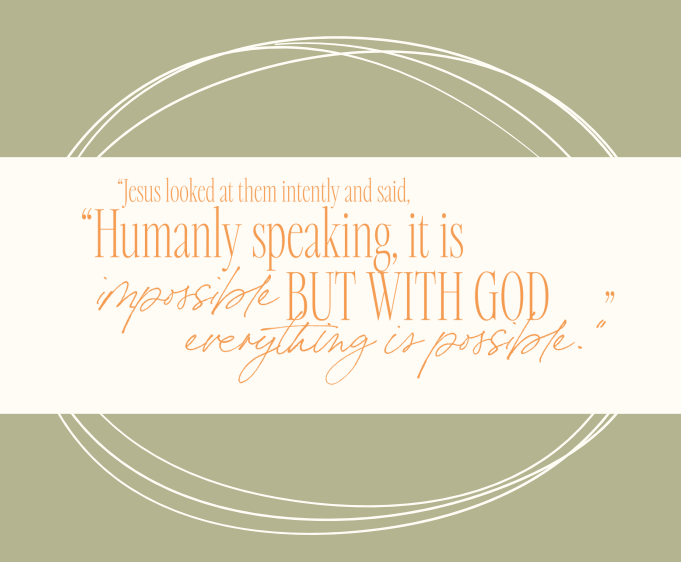
“She will be known for the boldness of her faith.” This line is emblazoned across the National Women’s Ministries webpage. In 2025, I want to challenge myself, and you, to be known by the boldness of our faith. This is not about what others think of us but instead what our lives can cause others to think about Jesus. I want others to see that when things are going well this year, I will thank Him and when things are not going well, I will trust Him. The theme verse for this year is Matthew 19:26, “With men this thing is impossible, but with God all things are possible.” It is audacious of us to believe even when it is impossible with the strength of this world. It is audacious of us to have faith when we are not enjoying the season where we are walking. The writer in Hebrews 11 reminds us that all we see in creation was made from what we cannot see. This is the evidence of what we hope for. This is Audacious Faith.
This year I choose not to make resolutions but instead to commit to living with Audacious Faith every day. I will pray with faith for signs and wonders and I will pray just as fervently for peace, patience, and greater faith than ever before.

About STX Women
We are the Women’s Ministries branch of the South Texas Assemblies of God.
Women across South Texas desire a community where we celebrate each other and share each other’s burdens.
Together, we walk out our God-given purpose in our family, church, and community!
Our passion and love for Christ unite us to reach the lost at home and across the world.
Follow Us On:
Subscribe To Our Emails
Enter your email address below to get our new blog posts sent right to your inbox!

